Does Medication Tell Us Anything About Patients?
Using the class healthcare dataset (2,608 patient records), I created these three charts compare the five medications by patient count, by medical condition, and by age. The question I wanted to answer: do different medications serve different kinds of patients?
The data
Summary of the full dataset, grouped by medication in Google Sheets (using pivot charts).
| Medication | Patients | Youngest | Average age | Oldest |
|---|---|---|---|---|
| Aspirin | 498 | 18 | 54.2 | 85 |
| Ibuprofen | 560 | 18 | 50.7 | 85 |
| Lipitor | 509 | 18 | 53.4 | 85 |
| Paracetamol | 481 | 18 | 50.6 | 85 |
| Penicillin | 560 | 18 | 49.7 | 85 |
| Total | 2,608 |
| Medication | Arthritis | Asthma | Cancer | Diabetes | Hypertension | Obesity |
|---|---|---|---|---|---|---|
| Aspirin | 88 | 75 | 70 | 91 | 74 | 100 |
| Ibuprofen | 62 | 102 | 100 | 94 | 95 | 107 |
| Lipitor | 85 | 63 | 96 | 86 | 101 | 78 |
| Paracetamol | 98 | 61 | 83 | 70 | 84 | 85 |
| Penicillin | 94 | 83 | 97 | 110 | 90 | 86 |
| Total | 427 | 384 | 446 | 451 | 444 | 456 |
Source: healthcare_dataset
1. Patients per medication
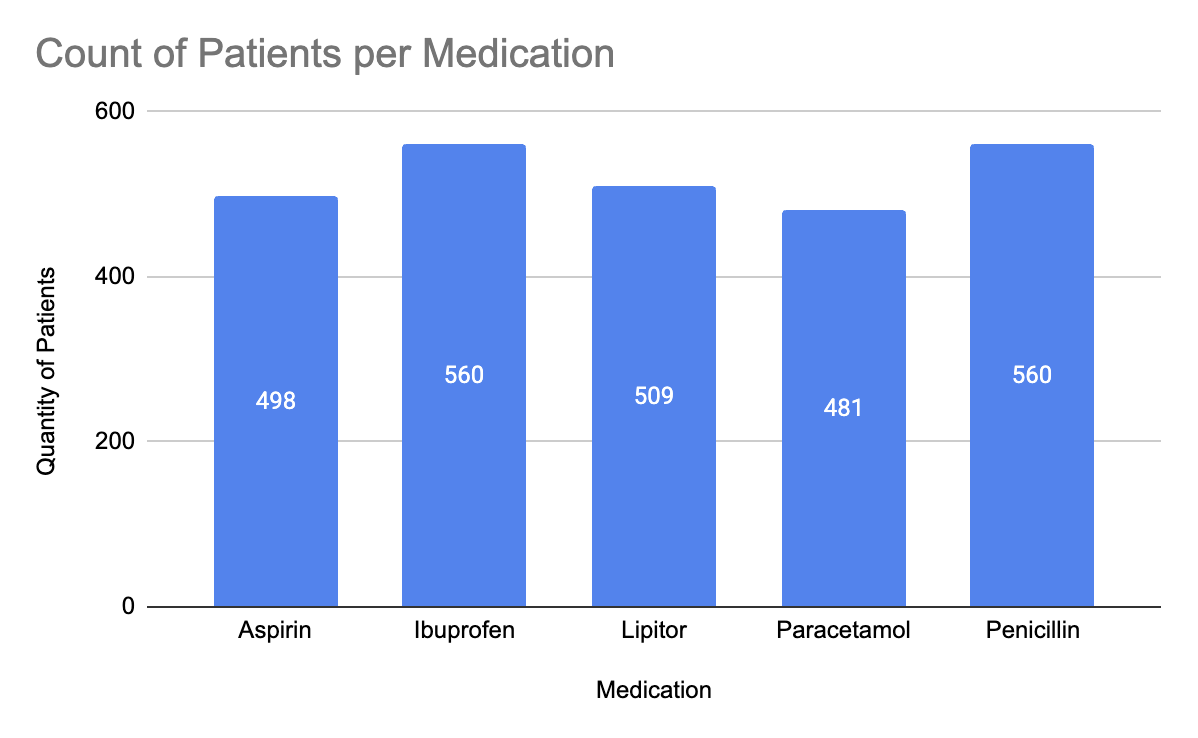
Each medication was given to between 481 and 560 patients, so every drug accounts for roughly a fifth of the dataset (18–21%). Ibuprofen and Penicillin tie for the most patients at 560 each.
2. Medication by condition
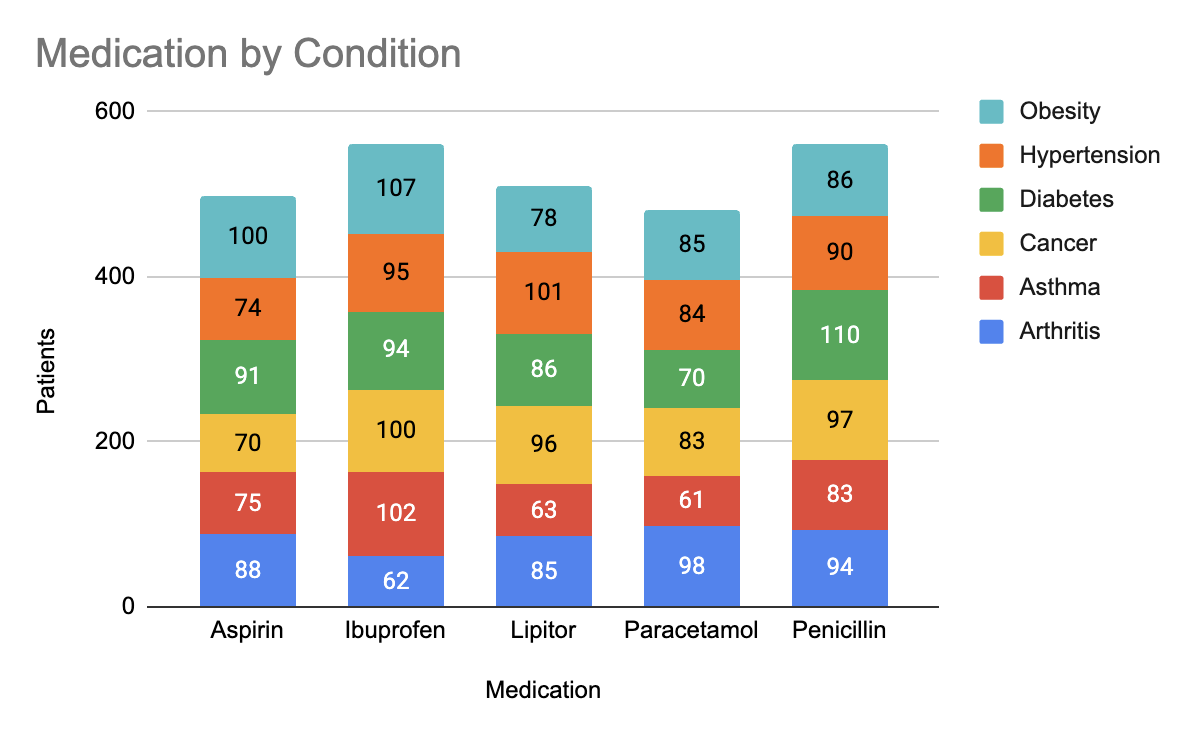
If medications were prescribed for real reasons, each bar would be dominated by the conditions that drug treats. Instead, every medication is spread across all six conditions in similar amounts. Penicillin, an antibiotic, is most often linked to diabetes (110). Lipitor, a cholesterol drug, is given to nearly as many cancer patients (96) as hypertension patients (101).
3. Age spread by medication
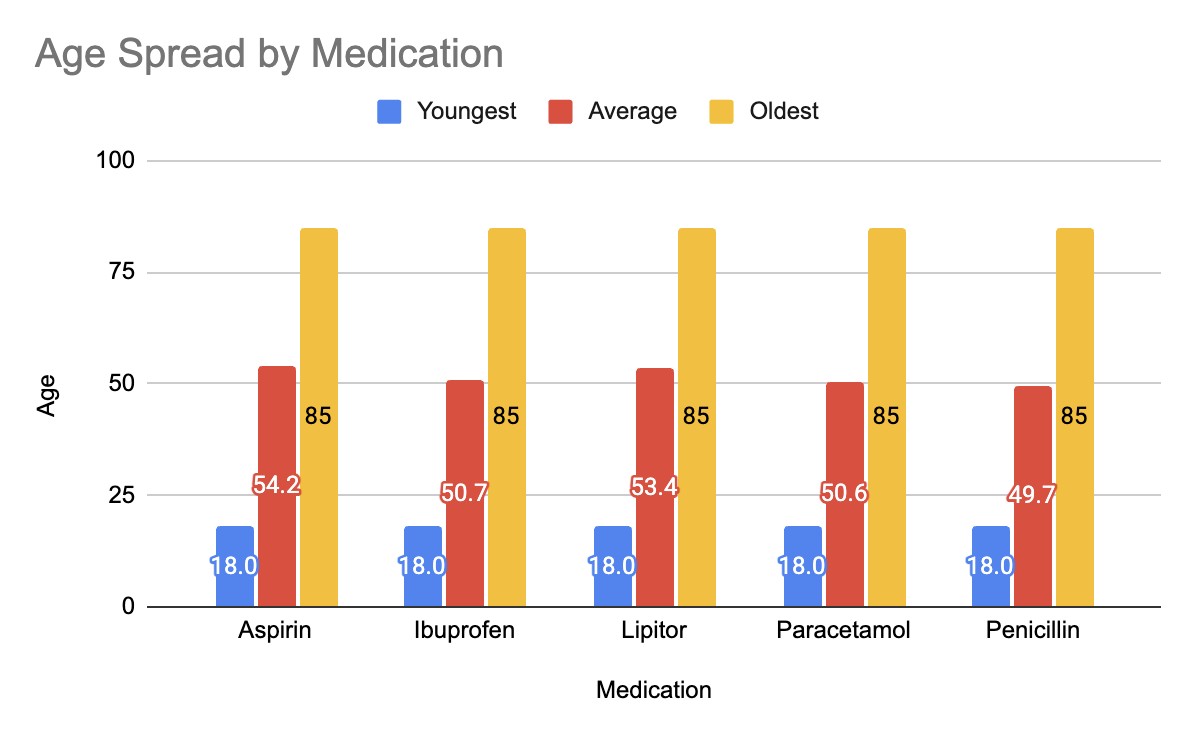
Every medication has exactly the same age range, from 18 to 85, and the averages fall within 4.5 years of each other (49.7 to 54.2). No medication skews toward younger or older patients.
Conclusion
Across all three views, the five medications are close to interchangeable. They have similar patient counts, the same mix of conditions, and the same age range. Here, I have to conclude that medication tells us nothing about who the patient is.